
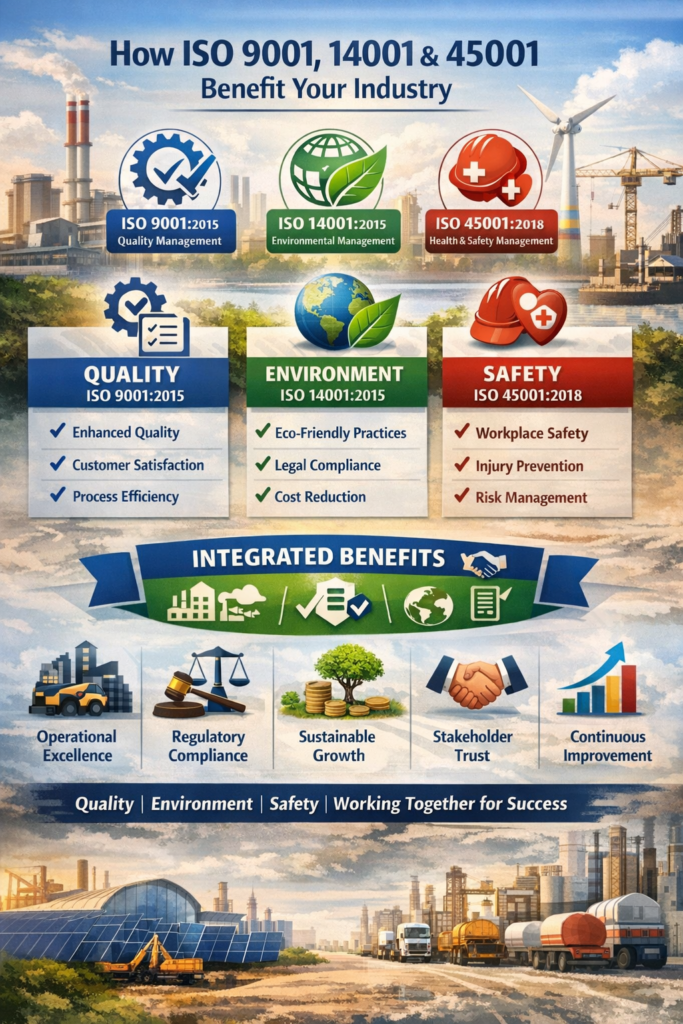
1. ISO 9001:2015 – Quality Management System (QMS)
Purpose: Ensures consistent product/service quality and customer satisfaction.
Benefits to Industry:
-
Improved Process Efficiency: Standardized procedures reduce errors, rework, and wastage.
-
Customer Satisfaction: Focus on customer requirements and continuous improvement.
-
Better Risk Management: Identifies risks and opportunities in operations.
-
Enhanced Market Credibility: Builds trust with clients, government bodies, and stakeholders.
-
Higher Employee Engagement: Clear roles, responsibilities, and performance monitoring.
-
Competitive Advantage: Many tenders require ISO 9001 certification.
2. ISO 14001:2015 – Environmental Management System (EMS)
Purpose: Helps organizations manage environmental responsibilities systematically.
Benefits to Industry:
-
Legal Compliance: Ensures adherence to environmental laws and regulations.
-
Reduced Environmental Impact: Controls pollution, waste, emissions, and resource usage.
-
Cost Savings: Efficient use of energy, water, and raw materials.
-
Corporate Social Responsibility (CSR): Demonstrates environmental commitment.
-
Improved Brand Image: Eco-friendly reputation attracts customers and investors.
-
Risk Reduction: Prevents environmental accidents and penalties.
3. ISO 45001:2018 – Occupational Health & Safety Management System (OHSMS)
Purpose: Provides a framework to improve workplace safety and prevent injuries.
Benefits to Industry:
-
Reduced Workplace Accidents: Identifies hazards and controls risks.
-
Legal Compliance: Meets occupational health and safety regulations.
-
Lower Insurance Costs: Fewer incidents lead to reduced premiums.
-
Improved Employee Morale: Safe workplace increases productivity and retention.
-
Business Continuity: Fewer disruptions due to accidents or legal issues.
-
Stronger Safety Culture: Promotes proactive safety management.
Combined Benefits of ISO 9001, 14001 & 45001
When implemented together as an Integrated Management System (IMS), industries gain:
-
Operational Excellence: Streamlined processes and better resource utilization.
-
Regulatory Compliance: Reduced risk of legal penalties.
-
Sustainable Growth: Balance between quality, environment, and safety.
-
Global Acceptance: Recognized worldwide.
-
Improved Stakeholder Confidence: Customers, investors, and regulators trust certified companies.
-
Better Tender Eligibility: Mandatory for many government and corporate projects.
-
Continuous Improvement Culture: Data-driven decisions and performance monitoring.
Why ISO Audits Are Important
ISO audits ensure that:
-
Systems are implemented correctly.
-
Processes are effective.
-
Legal and regulatory requirements are met.
-
Continuous improvement is happening.
-
Risks are identified and controlled.